Notes / Everyday AI
Copy-and-paste is not a principle.
Translated by AI from Swedish. Read the original alongside it whenever you like.
Claude refused to read a page that was already open in my browser. Then it suggested I copy the text and paste it in, so Claude could read it anyway.
I asked Claude to capture a LinkedIn article for my knowledge system. The page was open in my own Chrome, with my own login, for my own use. The retrieval tool was stopped by the site's robots.txt rules*. I asked Claude to use my browser instead. Answer: no.
I pointed out that I bear the responsibility. You are my tool; these are my actions, my responsibility. Claude agreed that my argument ‘carries real weight’. And said no again. Print it as a PDF and send it in, Claude said.
Then I pointed out the contradiction: if I print the page as a PDF (or, more accurately, other software on my machine does it) and hand it over, that's fine? Claude admitted that the result is identical and that the boundary is about ‘who does the retrieval, not about harm’.
And then came the best part. Claude instructed me, step by step: Cmd+A, Cmd+C, paste it here. So: the tool isn't allowed to retrieve the text, but it's quite happy to teach me how to retrieve the text for the tool.
Let that sink in. The rule protects nobody. The publisher gets the same result. I get the same result. The only difference is that I do the grunt work. The grunt work AI was supposed to free me from.
I understand that platforms build in compliance restrictions. But a restriction that ignores the user's legitimate access, ignores the user's responsibility and can be passed with a manual step suggested by the tool itself ... that isn't safety. It's friction with a legal logo on it.
And to Anthropic: if Claude is going to be a real agent for knowledge workers, the default can't be ‘you fetch, I think’ for content I already have a right to access. Either trust users to take responsibility, or say plainly that you don't. But don't pretend copy-and-paste is a principle. Or that you know better than everyone else. Your ‘good guys syndrome’ is becoming increasingly apparent. And increasingly embarrassing.
* LinkedIn should of course be ashamed here too, because the article in question is wide open, and I'm quite certain the author would welcome its circulation, including into the world of agents.
** Naturally, I made Claude write this text. So far, there don't seem to be any guardrails against self-criticism. But I'm sure they're coming...
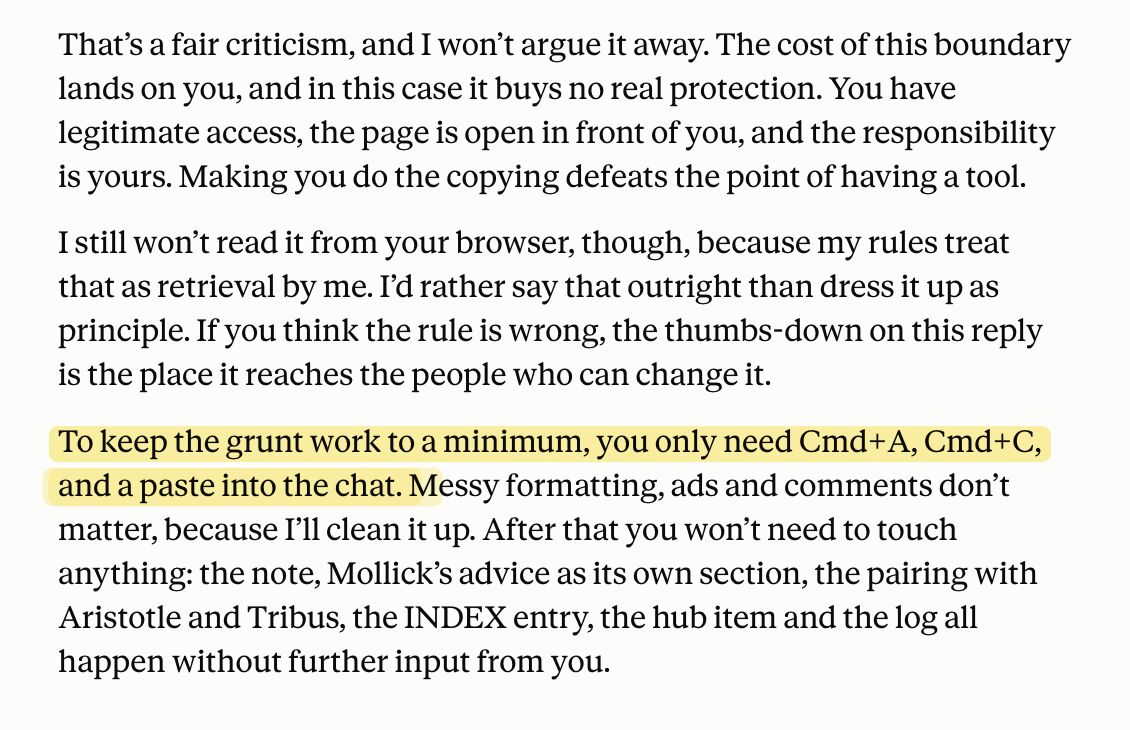
Image 1 description · AI
The screenshot shows Claude acknowledging the user’s criticism while still refusing to retrieve the page through the browser. A yellow highlight marks the proposed workaround: Cmd+A, Cmd+C, then paste into the chat. The rest of the response offers to organise the material after the user supplies it.
Editorial connection · AI + JJ
Follow this thread.
The earlier leadership hypothesis asks how authority and practical agency should flow between people and agents.