Karin had an attendance report and a task she’d done far too many times.
Open the report. Copy a name. Switch to Word. Paste it into the template. Go back. Copy the next name.
When I tell this story on stage, I sometimes demonstrate the sequence. People start getting uncomfortable remarkably quickly. We’re only a few names in and they’ve had enough.
Now imagine doing it after the next meeting. And the next.
For years.
Karin is an executive assistant at Volvo Group. She understood perfectly well what was wrong with this process. What she lacked was a way to change it herself. Then she tried something with Copilot, and a very small text hack became one of the clearest examples I know of what AI can mean for a person.
From word soup to a reusable helper
 Enlarge
01The word soup
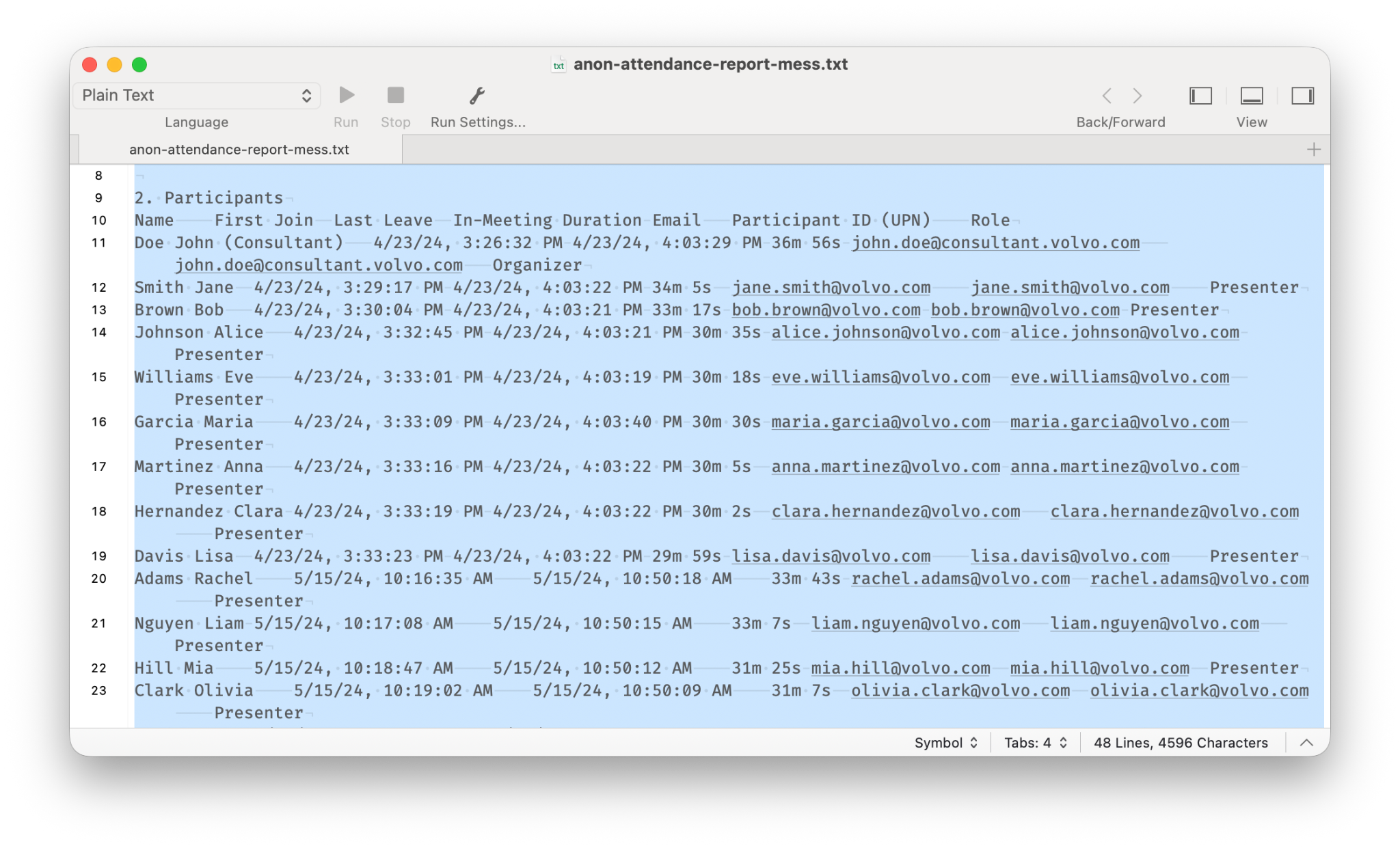
The report has everything. Karin needs a list of names. This is the material she used to pick through, one person at a time.
Read the image text and description
A text editor shows an anonymised attendance report. The columns include Name, First Join, Last Leave, In-Meeting Duration, Email, Participant ID (UPN) and Role. Visible participants include John Doe, Jane Smith, Bob Brown and Alice Johnson.
 Enlarge
02One small request
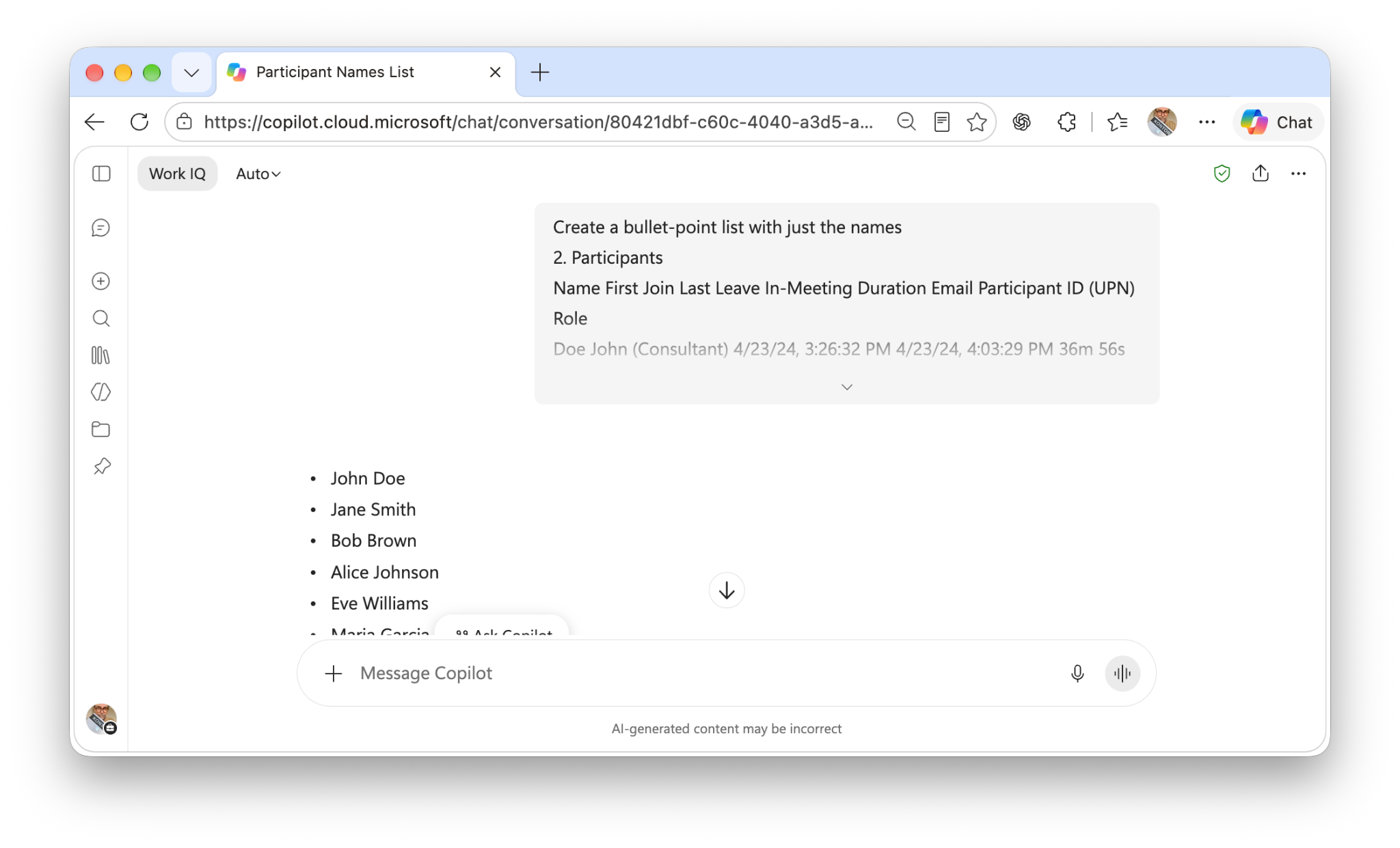
Copy the report, then ask for just the names. One ordinary sentence replaces the repeated switching between the report and Word.
Read the image text and description
The request and a portion of the response are visible. Copilot returns John Doe, Jane Smith, Bob Brown, Alice Johnson and Eve Williams as bullet points; the list continues below the visible area.
First promptCreate a bullet-point list with just the names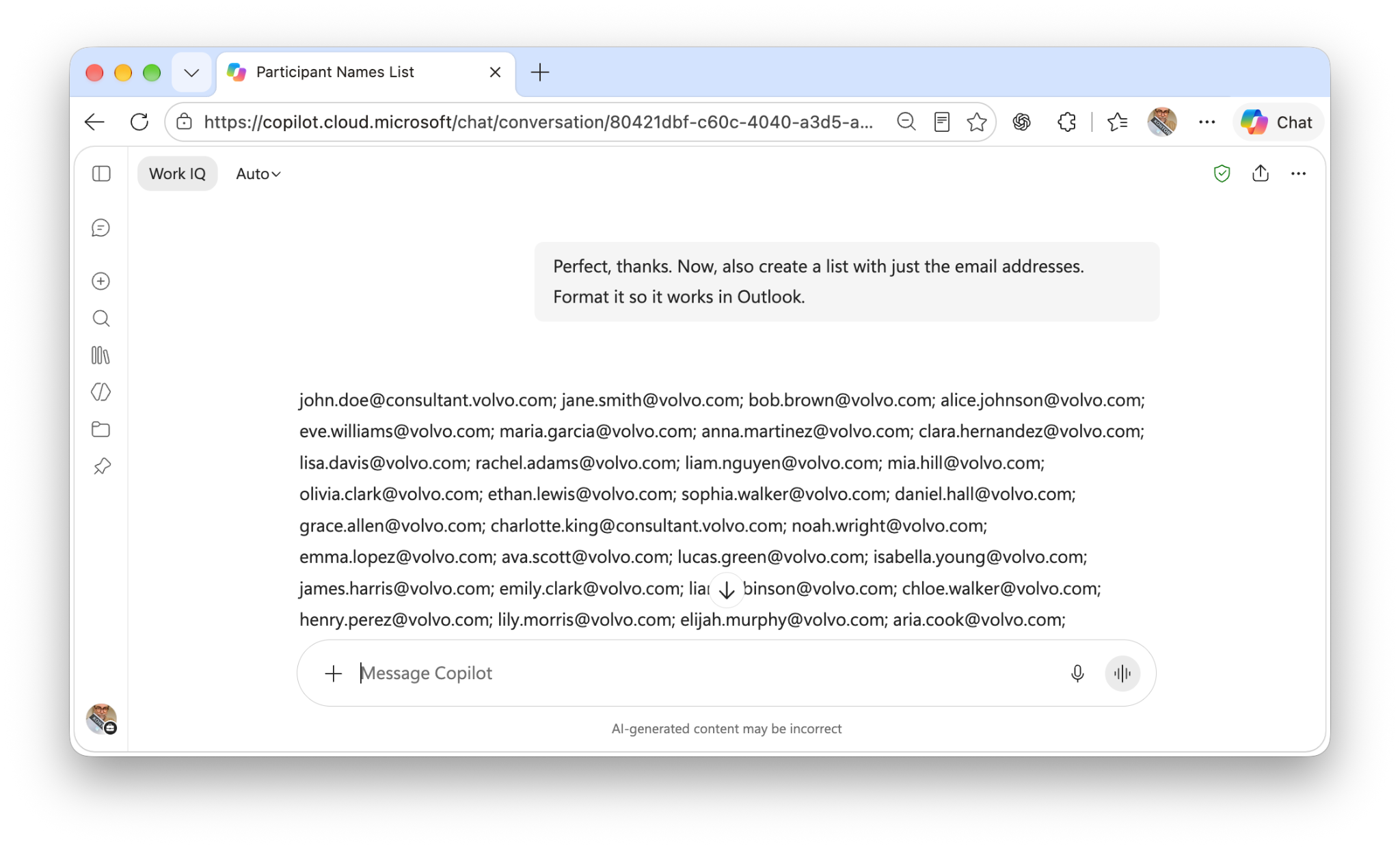 Enlarge
03Now make it useful for Outlook
The next request follows from the first. Extract the email addresses too, and put them in a form Outlook can use. The method grows through conversation.
Read the image text and description
Copilot displays email addresses separated by semicolons, ready to paste into an Outlook recipient field. The anonymised addresses correspond to the sample attendance report.
Follow-up promptPerfect, thanks. Now, also create a list with just the email addresses.
Format it so it works in Outlook.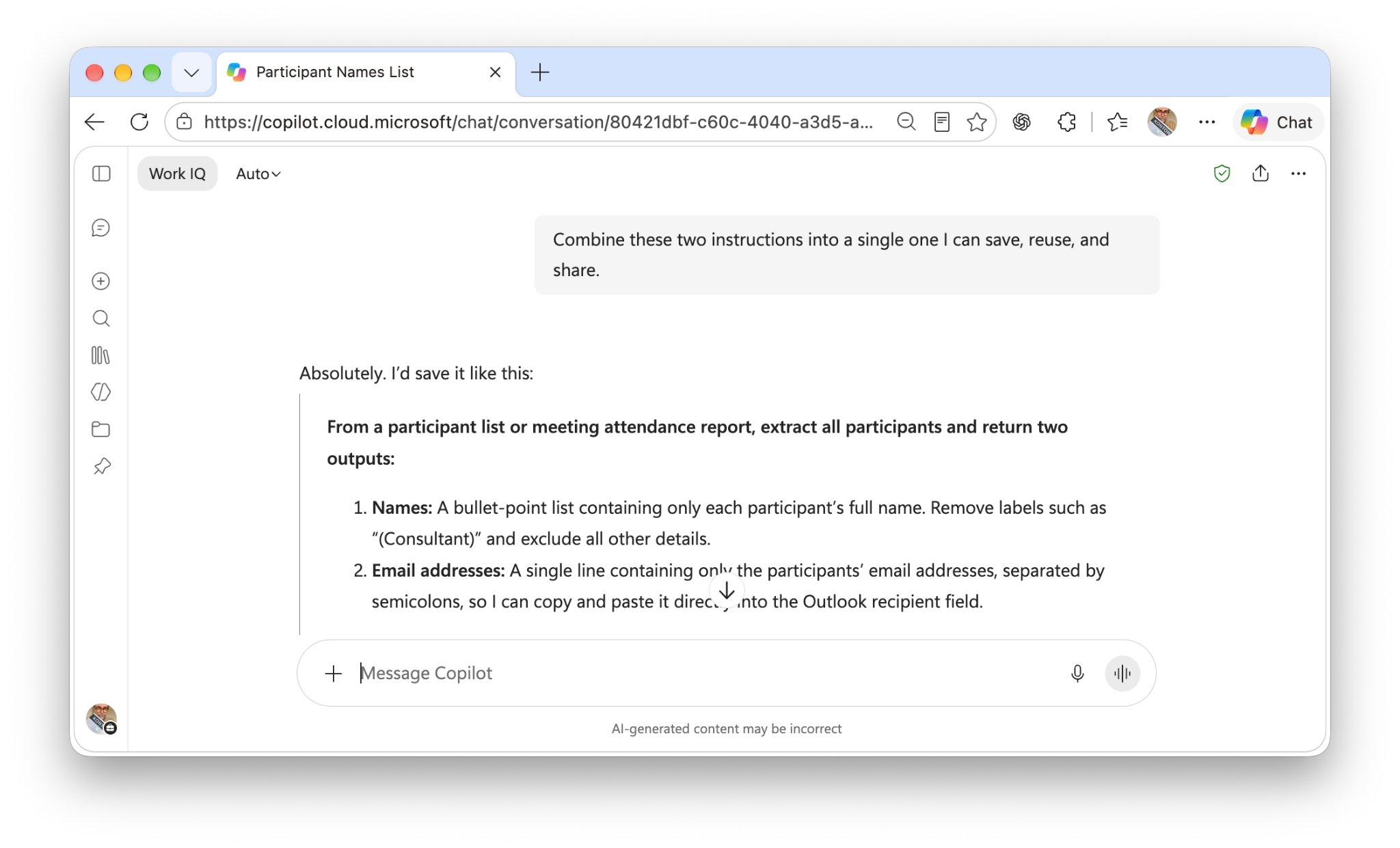 Enlarge
04Ask AI to help you work with AI
You don’t have to write the perfect reusable prompt yourself. Ask Copilot to combine what worked into an instruction you can save, reuse and share.
Read the image text and description
The screenshot shows the request to combine the instructions and Copilot’s resulting two-part prompt: a bullet list of full names, with labels removed, and a single line of email addresses separated by semicolons.
The request to combine the promptsCombine these two instructions into a single one I can save, reuse, and share.Reusable instruction · text versionFrom a participant list or meeting attendance report, extract all participants and return two outputs:
1. Names: A bullet-point list containing only each participant’s full name. Remove labels such as “(Consultant)” and exclude all other details.
2. Email addresses: A single line containing only the participants’ email addresses, separated by semicolons, so I can copy and paste it directly into the Outlook recipient field.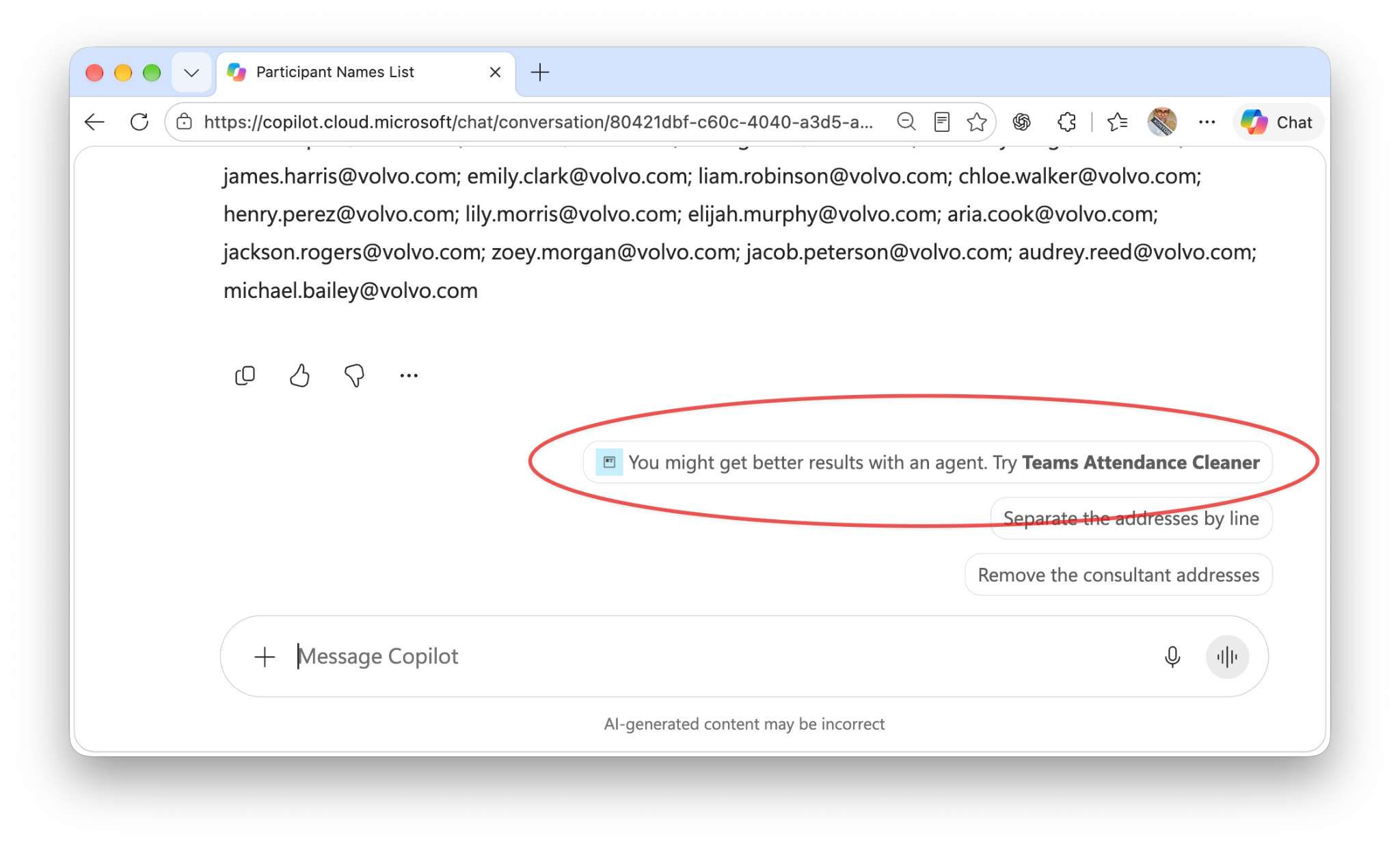 Enlarge
05The tool offers a nudge
In this reconstruction, Copilot suggests trying an agent for the task. Another possible next step appears inside the tool you’re already using.
Read the image text and description
A red oval highlights Copilot’s suggestion to try the Teams Attendance Cleaner agent. This is a suggestion displayed in JJ’s reconstruction, rather than a screenshot of Karin’s original conversation.
Copilot’s suggestionYou might get better results with an agent. Try Teams Attendance Cleaner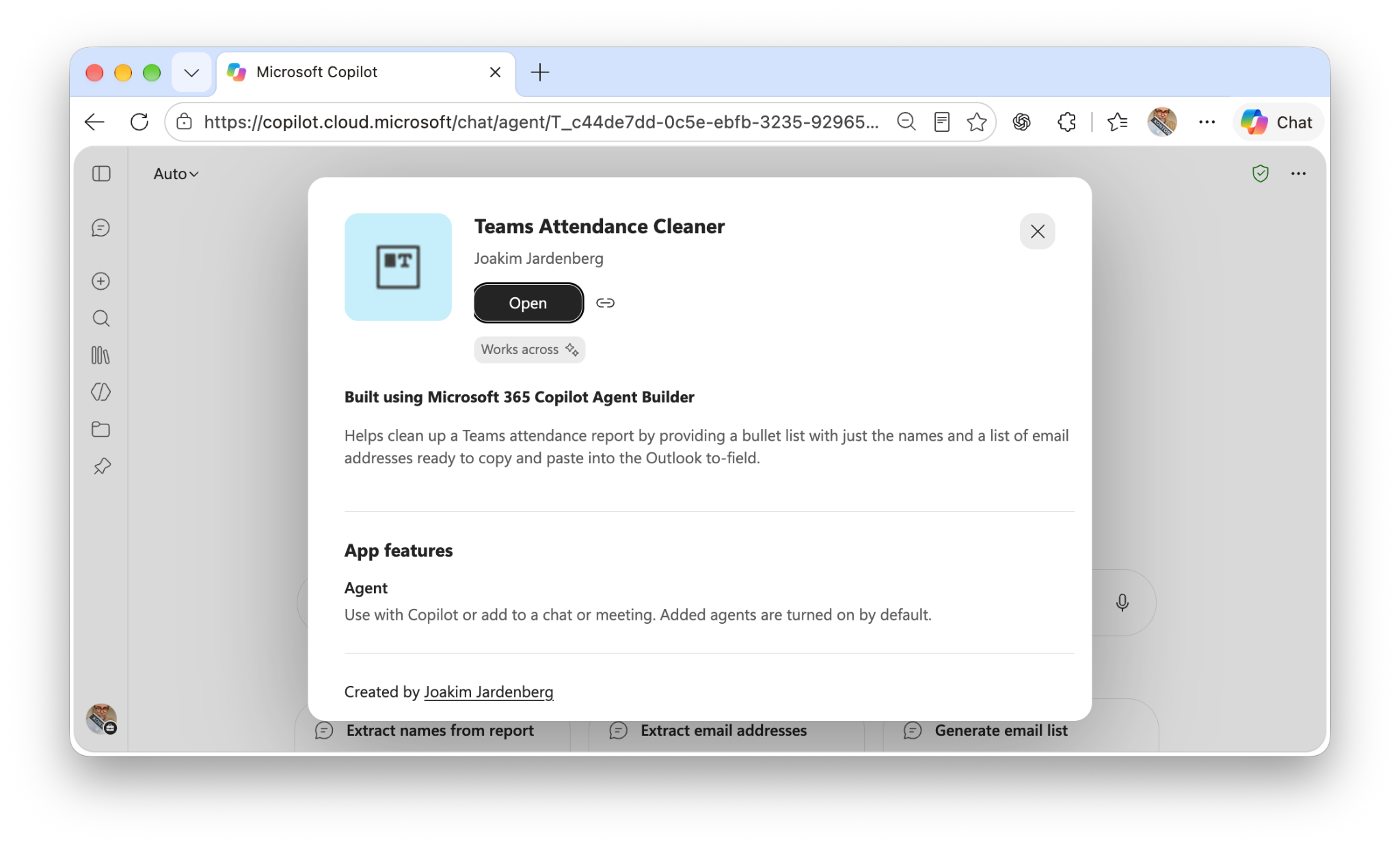 Enlarge
06The same idea becomes an agent
When agent-building became available, Karin turned her method into an agent. This is my replica, Teams Attendance Cleaner. A familiar task can keep developing as the tools gain new capabilities.
Read the image text and description
The agent card names Joakim Jardenberg as its creator and identifies Microsoft 365 Copilot Agent Builder. Its description says it cleans up a Teams attendance report into a bullet list of names and email addresses ready for Outlook. The screenshot documents the replica and its stated purpose; it does not measure changes in output quality.
Agent descriptionHelps clean up a Teams attendance report by providing a bullet list with just the names and a list of email addresses ready to copy and paste into the Outlook to-field.
Recreated by JJ using an anonymised attendance report and the current Copilot interface. These six screens show the method developing over time; the last screen is my replica of Karin’s agent.
Screenshots: JJ. Microsoft interface and depicted content retain their own rights.
Karin knew the work already
I met Karin through Next Step, a seven-month development programme for seventeen executive assistants at Volvo Group. I’d initially been invited to do a forty-five-minute session on AI. We ended up working together throughout the programme, with regular AI office hours.
That gave us something a single presentation rarely can: time to bring real problems back into the room. Try something between sessions, show the others, get stuck, ask a question, try again. The work supplied the curriculum.
Karin has a spark in her eye and a willingness to give things a go. Early on, she decided to fire Google and hire Copilot. I love that formulation. It gave her a small behavioural trigger: when a question appears, try a different first move.
Hiring and firing will turn up again in this series. It starts here, with a person choosing what should help her do her work.
Her Teams report contained the information she needed, surrounded by information she didn’t. The Word template wanted a list of names. Karin had become the manual connection between the two.
She’d wanted help fixing that for a long time. To someone with the right programming skills, it was a small problem. In the larger organisation, it stayed unresolved.
A task can be small in an IT backlog and occupy a large place in someone’s day.
Take the whole thing
Instead of copying the next name, Karin copied the whole report into Copilot and asked for a bullet-point list containing just the names.
Out came the list.
All that switching between windows, all those individual selections, reduced to a much shorter operation. She could see the result and judge whether it was useful because she knew exactly what she needed.
No programming course before the first benefit. No specification handed over to somebody else. An ordinary request about a task she understood.
This is where the story gets interesting for me. The expertise was already there. Karin knew the job, the people and the standard the result had to meet. AI gave that understanding a route into action.
The process had been something she followed. Now it was something she could change.
Then someone asks for more
Karin showed the other sixteen executive assistants in our office hours. Suddenly, she was the person with something useful to teach the rest of us.
A colleague wanted the names arranged differently. There was also the next task: making an email recipient list for Outlook, so the message would go to the people who’d actually attended.
She tried asking for those changes, right there in the conversation. Extract the names, arrange them differently, produce the email addresses in a form she could paste into Outlook. Then, over time, combine the requests into one reusable instruction and share it.
Later, when the ability to build agents became available, Karin gave the method a more permanent home. She built an agent for it. I’ve recreated it in the screenshots above: the same familiar job, carried forward as the tools developed.
Look at how much happens in that little sequence. A result worth showing. A colleague who spots another use. An immediate attempt. A method that gets better because people are working on it together.
I’m fond of this part because it’s how so much useful learning actually happens. You don’t have to arrive with a finished invention. Bring something that helped you, let somebody ask a question, and see where that takes you.
Karin gained a useful method. The group gained a colleague they could learn from. And the next problem no longer had to look quite as immovable.
A level-one hacker
This is what I mean by going from n00b to level-one hacker. Spot a frustrating arrangement, try changing it, see whether the result helps.
The beginner label applies to the technical possibility. Karin was already a highly capable professional. There’s a lot of expertise in organisations waiting for a better way to become action.
But I want hacker to mean something more specific than using AI. Asking for help completing a task is useful. Changing the method, keeping the improvement and making it available for the next repetition is another kind of contribution.
Karin crossed that boundary. She improved how the work was done.
The first technical step was tiny. She could learn inside the attempt, using words she already had, on material whose purpose she understood. Our office hours and her colleagues gave her somewhere to bring the result and develop it.
That’s the entrance I want people to see. A small enough first move that they can try it in their own working day.
All Four Jobs, in one ordinary task
My Four Jobs framework helps explain why I keep returning to this example.
Job 1: Do the work. Produce the attendance list. People still need the result, and Karin still has a job to get done.
Job 2: Improve how the work is done. Change the recurring method. Make the next list easier to produce too.
Job 3: Improve yourself. Learn how to work with AI through a problem you understand. Build capability by trying and refining.
Job 4: Develop the team. Show your colleagues. Share the instruction. Let their questions improve what you’ve made.
There they are, all four, in a piece of everyday work that would be easy to dismiss as too small for a serious discussion about AI.
This is why protecting time for Job 2 matters. If every available moment goes into delivering today’s tasks, an absurd method can survive for years. The improvement keeps waiting because the work keeps arriving.
And once you discover you can change the method, another question becomes available: do we need to do this task at all? That came up when we discussed Karin’s story in a workshop. It’s a good question to carry into the next experiment.
Relief counts
We could start counting meetings, names and seconds per copy-and-paste. There’s a useful calculation to make there.
But spend a moment with what it feels like to be the person doing it.
There is a particular burden in knowing that a process is absurd while feeling unable to change it. Every repetition reminds you of the gap between the work you’re doing and the work you know would be possible.
Then you find a way to act. You can try something, inspect it, make a change. You have something useful to show a colleague. The next time a small problem appears, you’ve got another move.
That matters to me. So does the relief of removing something you dread from an otherwise worthwhile job.
We should ask whether people have more attention, confidence and energy left at the end of the day. We should also resist the reflex to fill every reclaimed minute with another assignment.
There is a life to have after work.
What happened. What I think follows.
Observed: In the learning journey I facilitated, Karin turned a recurring attendance-report task into a much shorter operation, tried refinements with colleagues and developed a reusable instruction to share. The requests in this retelling are paraphrased from my accounts of the experience.
My assessment: The important change was her ability to improve her own work. The frustration, relief and growing confidence belong in the account of value alongside efficiency.
My inference: Starting with a problem people already understand can make the first technical step surprisingly small. Ongoing support and peer learning helped here.
My forecast: More people will gain ways to change the digital arrangements around their work. The results will range from small text hacks to tools and services they can shape themselves.
Still open: How widely that capability spreads, what support people need and which improvements last. This story has no measured before-and-after study of time or wellbeing. It gives us a concrete experience to examine and learn from.
You can begin here
Find a small frustration in work you know well. Choose something whose result you can inspect. Bring it to an AI tool you can appropriately use for that material and explain what you want to achieve.
If it helps, ask what would make the next repetition easier. Then show someone. Their question might be the most useful next instruction you receive.
If you lead people, give them room to do this. Pay attention when somebody brings back an improvement. Ask what became lighter, what they learned and who else might benefit.
The companion essay follows the same instinct into replacing Rebrandly with JJ Links. That requires more tooling, access and technical support than Karin’s first move. There’s real distance between transforming a report in a chat and operating a deployed service.
Karin doesn’t have to travel that whole distance for her discovery to count. Her working day was worth improving.
We will all be hackers. This is where I want the conversation to begin.
Sources and scope
JJ’s first-hand account as facilitator of the Volvo Group Next Step learning journey, revisited through workshop and keynote transcripts. Karin has given permission to share her story. First published 23 October 2026; revised 24 October 2026. Writing: AI + JJ. The screenshots are JJ’s reconstruction with an anonymised report in the current Copilot interface; the agent shown is JJ’s replica of the agent Karin built.